|
| 서한 |
시정서한 |
|
| 매체 |
웹사이트
|
|
| 이슈 |
동해
|
|
| 언어 |
영어
|
|
| 서한보내는곳 |
http://factsanddetails.com/japan.php?itemid=860%20=26%20=160 |
|
| 오류내용 |
동해를 sea of japan으로 잘못 표기 |
|
| E-mail / Contact |
|
|
서론 |
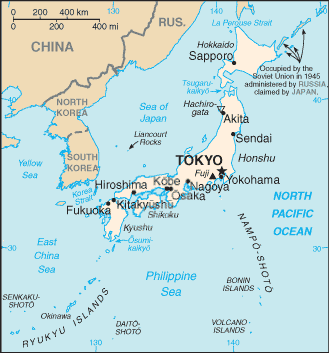
 With the Pacific Ocean to the east, the Sea of Japan to the west and the East China Sea to the south, Japan is an archipelago comprised of four major island and 6,800 smaller islands. Covering about 145,856 square miles (378,000 square kilometers), Japan is slightly larger than the United Kingdom, slightly smaller than California, approximately the same size as Germany, Finland, Vietnam, or Malaysia, and one twenty-fifth the size of the United States. The nearest countries are Korea (about 100 miles to the west), Russia and China. Japan is divided into state-like 47 prefectures. With the Pacific Ocean to the east, the Sea of Japan to the west and the East China Sea to the south, Japan is an archipelago comprised of four major island and 6,800 smaller islands. Covering about 145,856 square miles (378,000 square kilometers), Japan is slightly larger than the United Kingdom, slightly smaller than California, approximately the same size as Germany, Finland, Vietnam, or Malaysia, and one twenty-fifth the size of the United States. The nearest countries are Korea (about 100 miles to the west), Russia and China. Japan is divided into state-like 47 prefectures.
|
|
| 본론 |
The islands of Japan make up less than 15 percent of Japan’s total territory. Most of its territory is in the sea. In addition to the 200 nautical miles (370 kilometers) of ocean that Japan can also claims around the main islands according to the 1982 United Nations Convention of the Law of the Sea it can also claim 200 nautical miles around far flung Japanese islands that extend from near Taiwan and China to far out in the Pacific Ocean.
|
|
| 결론 |
In terms of latitude, Japan coincides approximately with the Mediterranean Sea and with the city of Los Angeles in North America. Paris and London have latitudes somewhat to the north of the northern tip of Hokkaido. About 12.7 percent of the country is good for agriculture (compared to 21 percent in the U.S.) and most of this arable land is along the coast or in the river valleys between the mountains on the main islands. Mountains ranges and volcanos (some still very active) cover about 68 percent of Japan. Large plains around Tokyo and Osaka that once contained a lot of farm land are now heavily urbanized. Only 1.7 percent of Japan is covered by pastures and grasslands.
|

































 조회 : 2,152


